
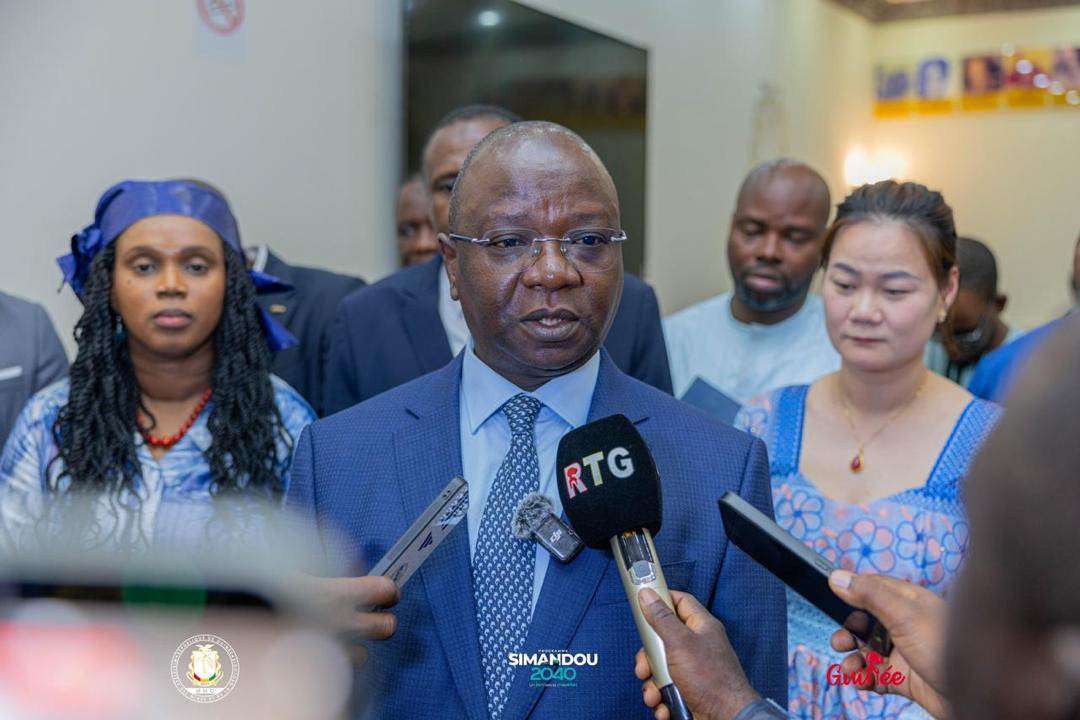

The Guinean government has decided to increase the level of foreign currency that mining companies must repatriate to the country after selling their products abroad.The announcement was made on March 31, 2026, during a meeting held at the Ministry of Mines and Geology. On this occasion, Minister Bouna Sylla, accompanied by the Minister of Economy and Finance, Mariam Ciré Sylla, the Governor of the Central Bank of the Republic of Guinea, Karamo Kaba, as well as the First Vice-Governor, Mohamed Lamine Conté, informed representatives of mining companies that the threshold for repatriation of foreign currency from mining exports is now set at a minimum of 60%.
This initiative aims to establish a permanent dialogue framework between the Guinean state and stakeholders in the mining sector, focusing on issues related to the mobilization and management of resources derived from mining activities.
Strengthening foreign currency reserves
According to the government, this decision primarily aims to strengthen the foreign currency reserves of the Central Bank of the Republic of Guinea. By requiring mining companies to repatriate at least 60% of the revenues from their exports, the state intends to stabilize the Guinean franc, support monetary policy, and ensure better mobilization of financial resources to serve the national economy.
“We have a resilient economy, and a large part of this resilience comes from the mining sector. We need to diversify our economy, and we want to take advantage of the mining boom to offer opportunities and hope to Guineans. A large part of this will come through the repatriation of mining revenues,” explained Karamo Kaba, Governor of the Central Bank.
The level of repatriation of mining revenues, currently set at 50%, will be gradually increased to reach a target between 60% and 70%. For the Minister of Mines and Geology, it is only natural that mining revenues be domiciled in Guinea, especially since their generating effects are located there.
“We discussed this issue to encourage mining companies to respect this commitment, which is currently applied at about 50%. We want to raise this threshold to 60%, or even 70%. In return, mining companies have expressed some concerns about being able to meet this level. The generators of these exports are located in Guinea, so it is only natural that their revenues be domiciled in the country,” said Bouna Sylla, Minister of Mines and Geology. This meeting brought together representatives of several mining companies operating in Guinea, gathered within the Chamber of Mines of Guinea.